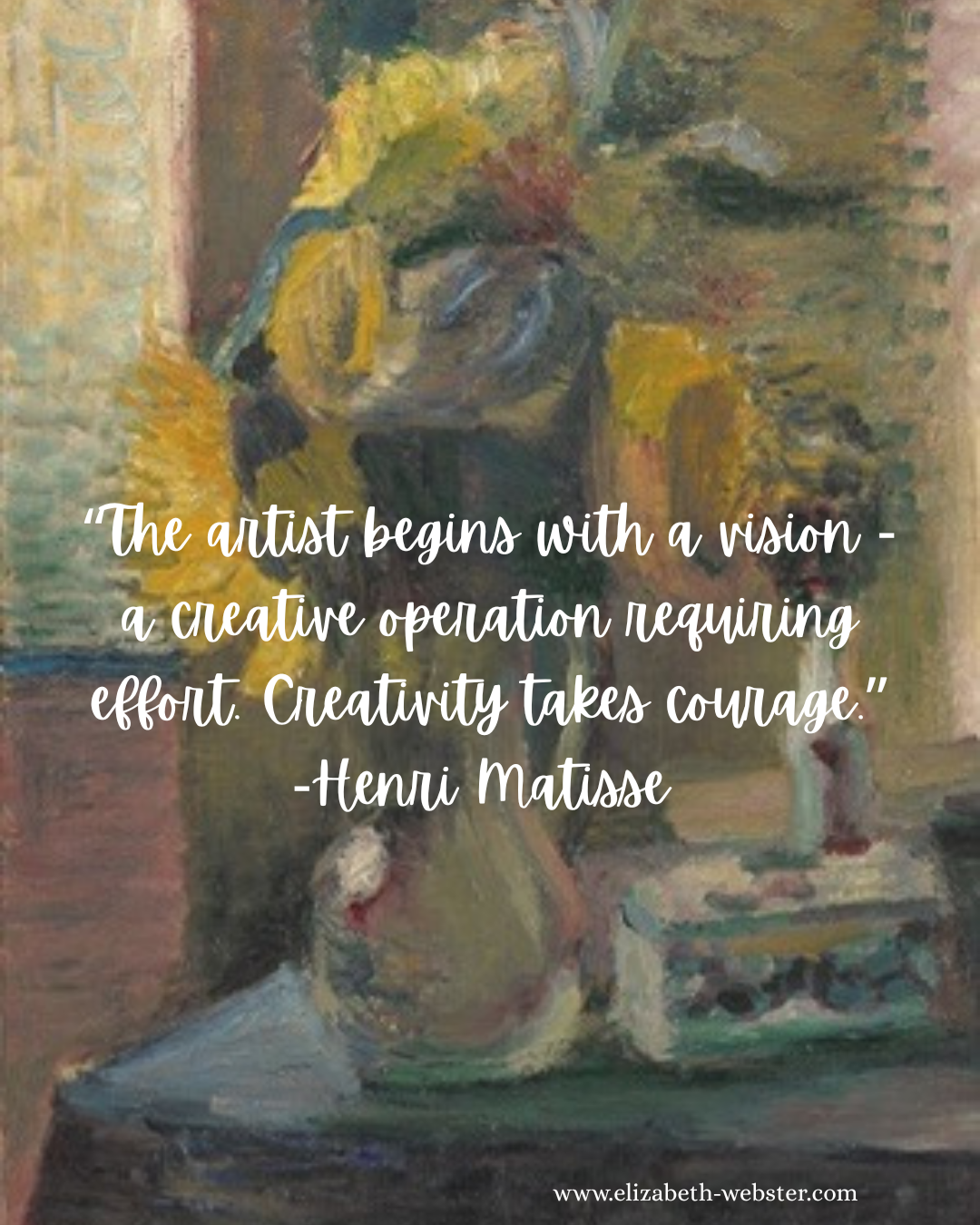
Matisse, Henri. Sunflowers in a vase. 1896-1899. Oil on canvas. Statens Museum for Kunst. Public Domain via Curationist.
I love learning about others’ creative routines, and I often find inspiration to shake up my own habits by discovering how others manage their time. Social media has taken the sharing of these rituals to new heights. Now, we can easily see a writer’s desk or a sculptor’s studio. An artist might share the view from their recent retreat. A speaker might offer a glimpse from their vantage point, waiting in the wings. These private moments have become curated, aesthetic, and easily shareable.
But what about the creative rituals that are invisible to the outside world?
I don’t often hear people discuss one of the most difficult aspects of creative work: holding a vision that no one else can see. Below, I’m offering three guideposts to keep in mind as an idea takes shape in reality.
Because as artist Henri Matisse acknowledged, “An artist begins with a vision—a creative operation requiring effort. Creativity takes courage.”
Matisse, who experimented throughout his career with color and brushstrokes and even paper cut-outs, understood well the work of innovation. His vision lived in his mind, but breathing life into his ideas required a commitment that others often couldn’t envision until he’d completed his work. Now, we can see Matisse for the genius he was, recognize his contributions, and sense what he was trying to create. Yet he had critics in his era, too.
He famously noted, “I do not literally paint that table, but the emotion it produces upon me.” Though Matisse participated in different artistic movements, such as Neo-Impressionism and Cubism, he still pushed the boundaries of the status quo. After all, many in his lifetime wanted a table to look like a table.
But Matisse, ever a seeker of “the essential character of things,” held tight to his own vision instead.
How can we remain true to a vision, particularly after others can see it well enough to offer their input? I’ve landed on three suggestions that have helped me in the tricky endeavor of walking the creative path from idea to expression.
Remember Your intention
In The Seat of The Soul by Gary Zukav, Zukav theorizes that: “You create your reality with your intentions.” Zukav’s idea is that intentionality affects the quality and spirit of an outcome, and that intentions are never neutral.
Admittedly, I didn’t have a conscious intention when I wrote Summer Triangle, as much as an instinct to create it. After I’d finished the first draft however, certain truths came to light for me. I’d written about three isolated women coming home to a rich “found family” dynamic when I, due to certain circumstances, had been quite isolated. I’d written about longing for the coastline from my home in a landlocked state. I’d written about a second act (in three parts) when my children were starting full-day school, and I was on the cusp of coming into my own new chapter.
For me, “the essential character” of Summer Triangle was put into sharp relief only after its completion. But after its release, there was also you. I hadn’t counted on how your reactions would affect my intention going forward.
A dear friend texted that the book had given her “such a warm feeling” after she’d completed reading it. I found her sweet text so poignant in the moment, because I realized how much cultivating heartwarming emotions for readers matter to me.
It’s not only the quality of the fictional read, right? It’s the feeling, too.
I don’t want readers to turn the last page of my books feeling unsettled or frightened or distraught. I want you to feel like you’ve been on a journey, but I also want you to come to a place of peace (with the main characters) on the other side of it. And while I might not have been conscious of this intention the first time around, this goal is at the forefront of my mind as I edit the sequel.
Find Where You Belong
When I decided to share Summer Triangle with the world, I wasn’t sure how to describe it to publishing professionals. I was so green. My novel was escapist, yet full of raw emotion. I wanted it to be hard to put down, but I cared about the quality of my book’s language, too. And in highlighting the many demands modern women confront in their late thirties, I aimed to show the full arc of three women validating their experiences and reclaiming their power together.
I had no idea what to call it.
Eventually, I learned the industry term, “upmarket.” “Upmarket” fiction describes books that maintain commercial appeal with literary quality prose. Bingo! I eventually came to describe Summer Triangle as upmarket women’s fiction. As soon as I’d nailed down its category, I understood more about my book, my demographic, and—oddly enough—my intentions.
As soon as I recognized Summer Triangle’s category, I saw the vision for my book more clearly. I recognized that I wasn’t entirely walking on my own path, as so many other writers had come first, offering my creative instincts a home and clarifying my vision.
Initially, I worried that I’d lose my book’s special attributes to a group, and I do think it’s important to not blend in so much that we give our vision away. But, just as Matisse learned in experimenting with distinct artistic movements, categories can serve as a springboard for further innovation. Belonging can bind our vision to something bigger, while also putting highlighting our creation’s individuality.
And as soon as I learned where my book belonged, I also learned the unique qualities of Summer Triangle that made it special. The category taught me how to describe those details to my audience, too.
As an aside, its sequel will also fall within the upmarket women’s fiction category. My second book has a similar emotional arc, descriptive language, and an ensemble cast, yet suspenseful thriller undertones this time as well. Stay tuned!
Remember To Pause
The first time Summer Triangle was professionally edited, I received my developmental edits with a powerful piece of advice attached: do not touch this for at least a week or two.
My editor was reminding me to take my time, to let her suggestions marinade, and to consider how to weave her input into my vision. She nudged me to pause.
For the record, every editor I’ve ever worked with has improved my work immensely. I’ve always been grateful for a second set of eyes on my drafts. They ask big picture, developmental questions, while also line editing sentences with surgical precision. In a world that often debates whether the forest is lost to the trees (or vice versa), editors somehow miss nothing. They buff rough gems to a shine, every single time.
But the pause is important, too. No matter the form of creative expression, taking a moment to sit with a critique before implementing it is so powerful. This is the moment that reminds us of our own agency. Because a suggestion lacks force until we accept it, and our vision will remain untouched until we decide to refine it.
The decision is always ours to make.
Also, the person offering the opinion matters, too. I respect my editors deeply. I value their experience, their eye, and their own specific vision (even when it clashes with mine). That respect makes the first glimpse of redlining much more palatable.
Matisse cared about the person delivering the critique, too. He stated, “Only one person has the right to criticize me. That is Picasso.” Along similar lines, Picasso held firm that, “All things considered, there is only Matisse.” These two artistic powerhouses shared by a rivalry and a reverence for each other. Now, critics may debate the nature of their quasi-frenemy relationship, but the deep regard they held for each other can’t be denied.
Regardless of how I’ve felt about the edits I’ve received, I’ve always felt better for taking a moment to pause. Sitting in that space between creating and collaborating offers more inspiration, not less. After flowing, that quiet reflection point can feel jarring and fallow; it isn’t. I think you’ll find, if you take that time, that you’ve assessed your vision with new eyes.
And you’ll know exactly what to do.
How do you hold a creative vision that no one else can see?