Annie Dillard’s Wisdom on the Good Life
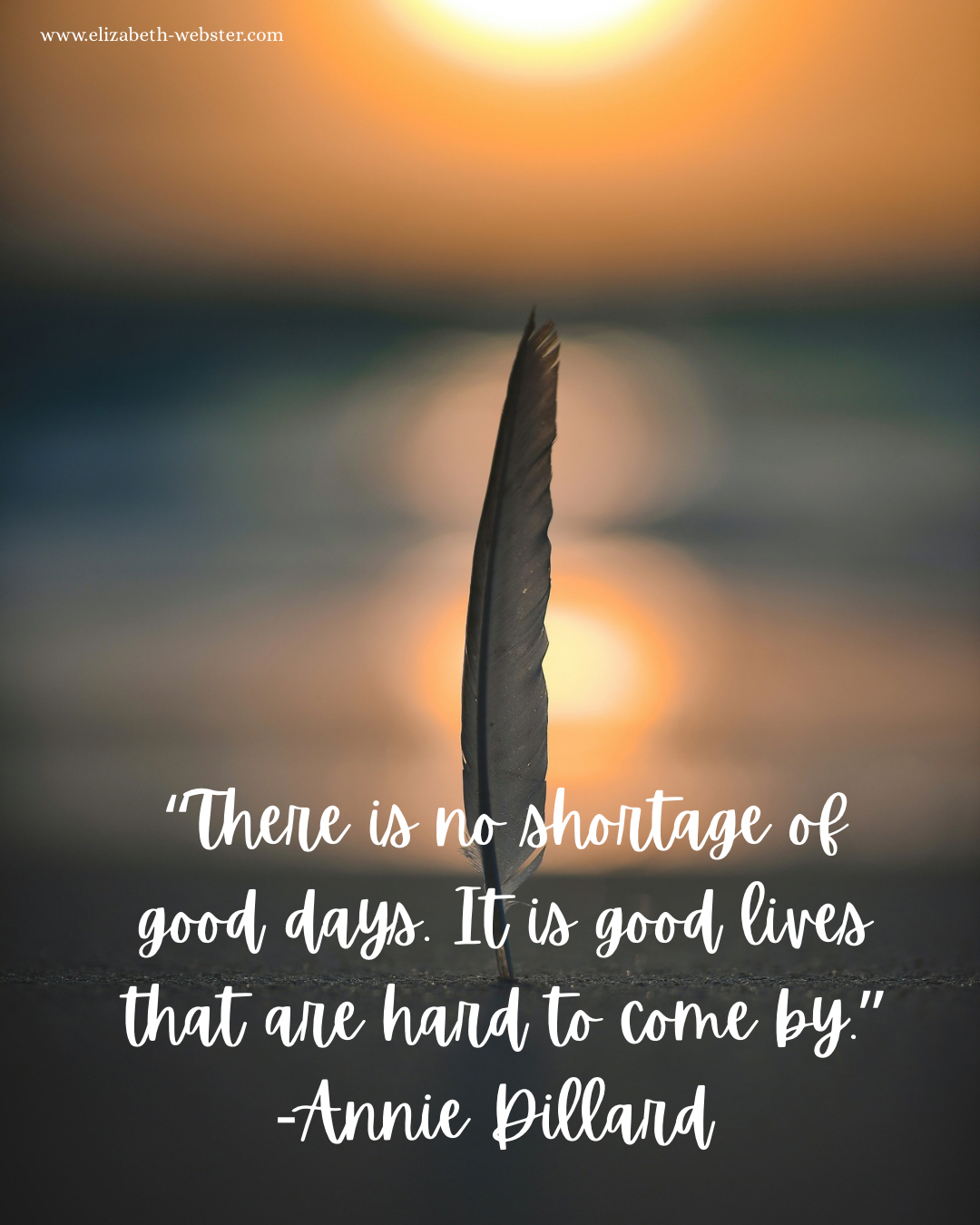
Earlier this week, we lost a literary luminary when author Annie Dillard died. Dillard was an American author who won the Pulitzer Prize for her book, Pilgrim at Tinker Creek. But many writers know her best for her seminal craft book of essays on writing, The Writing Life, which was published in 1989. I first discovered Dillard through this book. While Dillard obviously wrote The Writing Life for writers, her advice is valuable for anyone seeking to live a good life.
And in honor of Dillard’s extremely good life, I’m sharing some of my favorite gems from The Writing Life. Because over time, I’ve come to value Dillard most for:
Her sense of urgency
“Write as if you were dying. At the same time, assume you write for an audience consisting solely of terminal patients. That is, after all, the case.”
From the jump, Dillard cautioned writers against becoming complacent. She attempted to light a fire under us. In urging us to recognize our own impermanence, she conjures the energy not only to write but to also consider the legacy we wish to leave. For Dillard, the point is to write the book we must finish before the finish line. And to never lose sight of who will read our words after we’re gone.
Is it dark to consider the end before even beginning?
Maybe, but I value Dillard’s instruction to not waste time (ours or someone else’s). The stories we tell should matter. They should spring from a place of vitality, as the urge to connect through storytelling is one of our most primal rituals. When we tell our stories, they don’t belong to us anymore. The knowledge that they’ll become part of the collective wisdom (and maybe even outlive us) should inspire us to take care in their telling.
But perhaps the most important stories we’ll tell are the ones we’ll never share. These are the stories we tell ourselves about our own imperfect efforts to lead good lives, and they imprint the lives we live most of all.
Her sense of presence
“One of the things I know about writing is this: spend it all, shoot it, play it, lose it, all, right away, every time. Do not hoard what seems good now for a later place in the book or for another book; give it, give it all, give it now. The impulse to save something good for a better place later is the signal to spend it now. Something more will arise for later, something better. These things fill from behind, from beneath, like well water. Similarly, the impulse to keep to yourself what you have learned it not only shameful, it is destructive. Anything you do not give freely and abundantly becomes lost to you. You open your safe and find ashes.”
So many times, I’ve had an unexpected idea (a gift, really) come to me while writing, and I’ve considered setting it aside for later. I always recall Dillard’s advice to fight this instinct. I’ve come to realize that my impulse to store these creative impulses away is rooted in fear. It speaks to a lack of trust that more is coming. Essentially, I have knee-jerk worry that the well will run dry.
This is an illusion.
Years of consistent writing have taught me there is no drought on the other side of flow. Moreover, using those creative sparks as soon as they find us builds self-trust. Because when we write from a spirit of abundance, we make our words less about our ego than our offering.
On my good days, I live life like this, too.
Her sense of practicality
“A schedule defends from chaos and whims. It is a net for catching days. It is scaffolding on which a worker can sand and labor with both hands at sections of time.”
Setting aside the beauty of Dillard’s imagery here, her larger point is a mundane one. Dillard reminds us that motivation alone rarely fuels us enough to begin. Rituals, routines, and daily habits are the workhorses of creative magic. If our routines are aligned with our values and goals, the “good life” takes shape over time, imbuing our creative practices with more meaning.
Whenever people ask me how I find time to write as a mom, I think they expect me to say that I drop everything when a flash of insight hits. I rarely do this. In actuality, I write the same way that I brush my teeth, work out, and fold laundry. Creative work requires a daily time commitment, and I weave writing time into my schedule the same way I do the most ordinary tasks.
Even for me, I find it initially beyond boring to sit down at my desk and stare at screen. However, in the process of muttering under my breath and deleting ideas and managing my imposter syndrome, something remarkable happens. The words come because I’ve shown up to meet them. And when I look back, I’m most proud of myself for having taken the time to fashion a net, trusting that I would find the words to fill it.
Her sense that our lives (and our stories) are not linear
“When you write, you lay out a line of words. The line of words is a miner’s pick, a woodcarver’s gouge, a surgeon’s probe. You wield it, and it digs a path you follow. Soon you find yourself deep in new territory. Is it a dead end, or have you located the real subject? You will know tomorrow, or this time next year. You make the path boldly and follow it fearfully. You go where the path leads … The path is not the work. I hope your tracks have grown over; I hope birds eat the crumbs; I hope you will toss it all and not look back.”
In Summer Triangle and in its sequel, the manuscript that currently holds my attention, I rewrote both first chapters. I deleted hundreds of words. I tightened scenes, deepened emotion, and killed my darlings. Dillard might have nudged me to go even further, as she has written about the value in starting stories over completely.
People don’t want to hear that authors kill their books before they have the chance to breathe, but I’ve done this. Dillard approves of tossing it all into the dumpster.
Because while we have to write a story from beginning to end, its meaning often becomes clear somewhere in the middle. I used to loathe editing. Now, I value the editing cycles as a kind of excavation. I recognize the story’s arc in the arduous process of removing it from the earth, dusting off layers of sediment, and turning it over in the light.
Real life works this way, too.
Dillard reminds us that the point of our stories becomes clear when we look back on the paths we’ve walked. Life requires that we step out into the unknown, digging out pathways without any sense of where they’ll lead us. But Dillard highlights that, in writing and in life, a path is also a sunk cost. We are not required to continue walking simply because we’ve already laid down tracks. At any time, we can pivot to walk someplace new.
We are never so beholden to a story that we can’t leave it behind and begin a new one.
Her courage
“The page, the page, that eternal blankness …; the page, which you cover woodenly, ruining it, but asserting your freedom and power to act …; the page, which you cover slowly with the crabbed thread of your gut; the page in the purity of its possibilities; the page of your death, against with you pit such flawed excellences as you can muster with all your life’s strength: that page will teach you to write.”
A blank page is scary. Every single time I begin to fill a page with words, I feel intimidated. I’ve learned to back off, to give myself grace as I’m finding my way. Beginning is never easy for me, but I’ve found that the only way forward is to resist the urge to critique the words as they flow. I try to surrender.
And as I give voice to my free-flowing thoughts, I mute my inner critique. The words come together, building momentum, until the feeling is like taking dictation. The story doesn’t come from me but through me. The sense of being a conduit is pure magic.
But that flow won’t find me unless I’m willing to stare down a blank page.
Recently, my son was nervous to try something new. He was anxious for the first day of the new thing. I told him everyone feels that way when attempting something for the first time. It’s itchy. It’s unnerving. The urge to retreat into a cocoon (a comfort zone) is real, but we do grow when we face the unknown.
In this sense, a blank page is an opportunity for courage. I’ve found that accepting its baked-in imperfections helps. The first draft won’t ever be perfect, but it might lay the groundwork for a new story. I return, over and over again, to blank pages for the promise of the stories to come.
One of my favorite quotes from Annie Dillard isn’t one that we often see: “The sensation of writing a book is the sensation of spinning, blinded by love and daring.”
I’ve loved when I’ve felt this tight-rope, toe-curling high while writing, but I’ve relished this feeling simply from living, too. Dillard, may she rest in peace, reminds us that these heady states of being are one in the same.
Do you have a favorite insight from Annie Dillard? I’d love to hear it!