An Interview with Interior Designer Michelle Dashiell
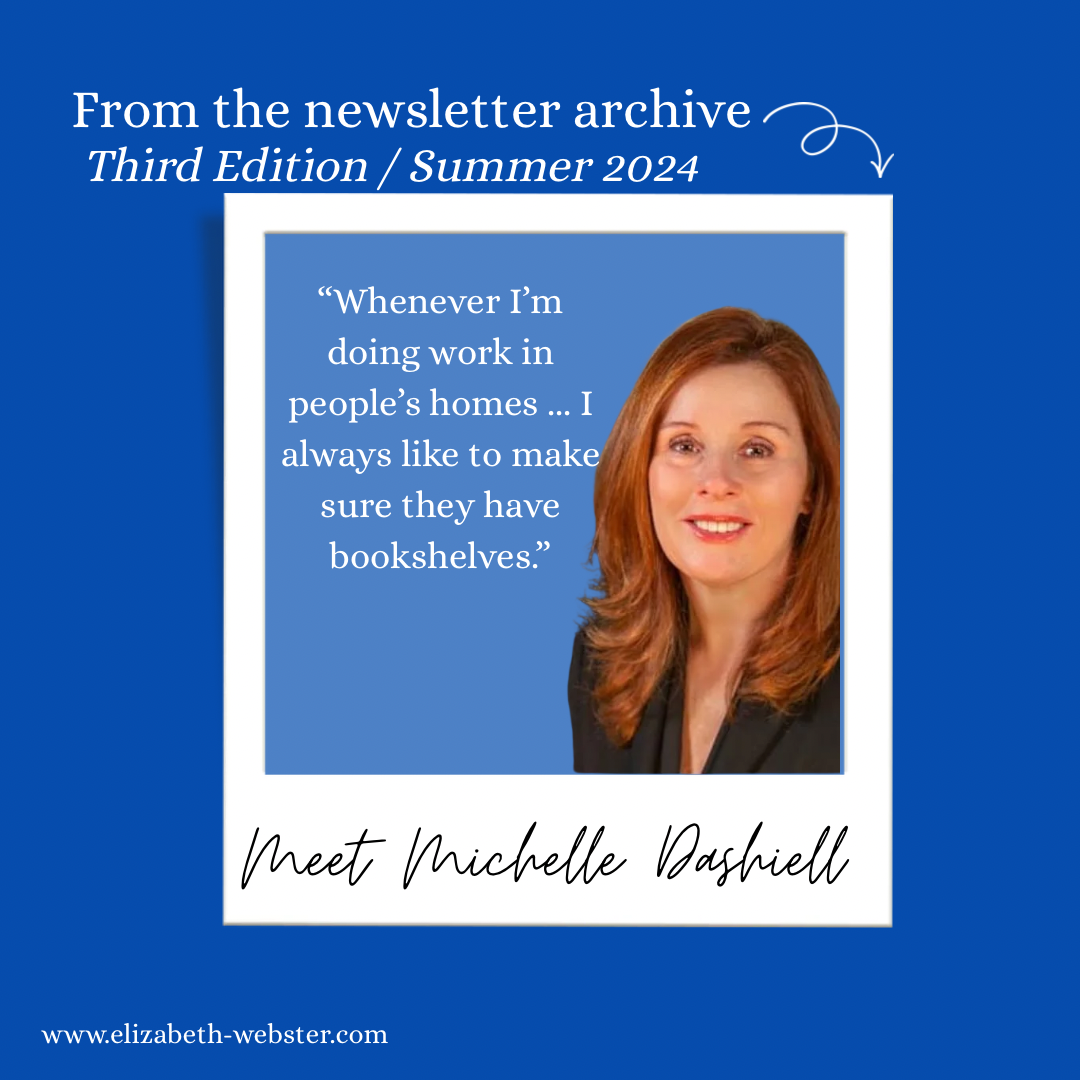
In the third edition of my quarterly newsletter, I was fortunate to interview Interior Designer Michelle Dashiell of Turquoise Interior Design. One of the primary themes of Summer Triangle focuses on the significance of “home.” Does “home” mean the people we share our life with? A defining landscape? A certain design aesthetic?
Michelle l was kind enough to offer insight into her work as an interior designer and to offer us tips on how to design homes that reflect who we are. You can read the full interview below.
Please note that this interview has been edited for clarity and length.
Elizabeth Webster: Hi Michelle! This is Elizabeth, how are you?
Michelle Dashiell: I’m doing well. Hi Elizabeth, how are you?
EW: I’m well. Thank you so much for speaking with me today …. One of the main characters in my book, Summer Triangle, is an interior designer, so I thought it would be really fun and immersive for readers to talk to someone who has the actual job …. Did you know always know you wanted to be an interior designer?
MD: No, I didn’t always know I wanted to be an interior designer. I actually went to school to be a nurse …. My husband is a luxury home builder, so I worked in the office with him and when we were launching his career…. I ran the office and did the books … and he did spec houses. I would make all the selections. Little by little, I started getting requests from clients and other people, so I started taking courses and doing things to educate and further myself along. Then, I organically started getting into more design work. It’s grown, and I’ve learned a lot over the years in a very practical sense.
EW: “Home” and the idea of home is one of the major themes of my book. When you speak with clients, do you find that home means different things to different people, or is there a sort of universal thread?
MD: I think because I’m in a resort [area] that the home can take on a different meaning for different people, because this may be a second home for them …. The approach is the same whether it’s their first, second, or third home, because you have to understand the way they live and what they want their environment to feel like and what the purpose of that particular home is for them. What are their family dynamics like? Do they have kids, or do they not have kids? Do they entertain or not?
EW: Speaking of entertaining, my book focuses on three characters who are good friends. I think entertaining is intimidating for a lot of people. So, to prioritize friendship, how can we make our homes … more hospitable and more open to inviting people in?
MD: My knee-jerk reaction is that the hostess and host make the home hospitable and inviting, not necessarily what’s in it. But [a home could feel more inviting] if it’s a relaxed environment and your home doesn’t feel like a model house or a showroom or a museum, if the house feels like the family that’s entertaining - if they’ve woven their life into their home with artifacts … from trips, family heirlooms, and pictures of their family.
EW: Setting is huge for me. I’m a landlocked girl and I miss the beach - it’s my happy place. So, how can people like me weave coastal elements into our home?
MD: That’s easy. Through color or lack of it. You can do sand tones in beige colors, and the different shades of blue. The blue-greens, the aquas, and teals. And then, you can throw in a piece of natural fiber through a rug or a chair or a headboard. You could have a really pretty clear container with a lid on it that’s full of shells or sea glass … a bowl in the center of your kitchen table could be full of shells.
EW: This is a selfish author question. I’m always looking for ways to bring more books into my home. I have young kids, and we’re always trying to get them to read. So, how can we design our homes to promote reading?
MD: Maybe create reading spaces. People sometimes have staircases that they drywall under, instead of utilizing that space under the stairwell to make a nook where you could put a little chair and lamp. Or, you could build a bench with a wall sconce. Or, in a big room, you might have a sofa floating and, behind it, you might have some extra room to put a couple of chairs facing in the opposite direction. It’s creating vignettes. I’m doing a home in Baltimore and the little girl … has a 6x6 alcove in her room, and I made that into a little reading nook. I put a small bookcase and a pretty rug and kind of a beanbag chair, a lamp, and some pretty art ….. She has her cozy space where she can lay and read ….. I love built-ins. I have a study in my home that’s filled with books. Whenever I do work in people’s homes - whether I’m doing architectural design or soft finishes (the furniture and the accessories), I always like to make sure they have bookshelves. Sometimes, it’s as easy as going to a library and getting the books they’re giving away and then staging with them.
EW: When you think about the work you do in your community, what do you want your legacy to be?
MD: That I was practical and able to give [people] the home of their dreams. That I was able to [give them] their happy place without breaking the bank. Everybody should … have a place where they get away from it all and nest and enjoy being in their environment.
I’m happy to share this wonderful interview with Michelle from the quarterly newsletter archive with you today. For the most recent interviews, recipes, event news, and even more bookish content, make sure to subscribe to my quarterly newsletter below!