An Interview with Artist Amanda Kimball
We’ve all heard the adage that a picture is worth a thousand words. And it’s true! As much as I love words, I do recognize their limitations. Among the reasons that I love writing about art and music is for the challenge of it. With art specifically, I’ve found it tricky to choose words that not only describe artwork but also a character’s emotional response to it in real-time. And though art is woven into Summer Triangle, this author’s descriptions were confined to my thousands (and thousands) of words.
For the fourth edition of my quarterly newsletter, I was thrilled to have the opportunity to speak with artist Amanda Kimball. Amanda shared insight into her background, her creative process, and her practical advice for those who hope to begin painting.
Please note that this interview has been edited for clarity and length.
Elizabeth Webster: Hi Amanda! Thank you so much for speaking with me today.
Amanda Kimball: Hi Elizabeth! I’m happy to talk with you.
EW: From your website, I’ve learned that you come from a family of “noticers” - I love that description. Did you always know you wanted to be a painter?
AK: I don’t think I envisioned myself as a painter in the professional sense. I spent a lot of my childhood with my grandmothers and mother who were intuitive and who showed me how to notice the quiet things. I always knew and felt I was creative, and it’s ebbed and flowed as I’ve followed its lead.
EW: In my book, a house plays a pivotal role. How does your past work in historic homes influence your artistic creations today?
AK: It was my grandmothers’ houses that first gave me an appreciation and feeling of aliveness in the home. [In my professional life], working at Nemours [Estate] in particular [was inspiring]. The rooms were more open with less boundaries, and as you walked through them, you had the immense feeling of wonder. Also, the architecture was incredibly interesting. Working at Nemours deepened my appreciation for architecture and for the essence of the home. The more time I spent there, the more I felt at home. All of the buildings are infused with history and aliveness.
EW: Do you have any rituals in your creative process?
AK: I would say there’s two ways to look at this. If I’m out in nature, I let what catches my eye draw me forward and lead. If I’m working on commission, I’m much more methodical and like to plan. I’m thinking about what the piece will end up on, whether silk or paper. There’s a lot of planning involved. But sometimes, if I wake up [inspired], I’ll try to sketch [my idea] quickly before it goes away.
EW: I love the premise of your nature journaling workshops, particularly your effort to draw literature and poetry into the experience. What inspired this innovative idea?
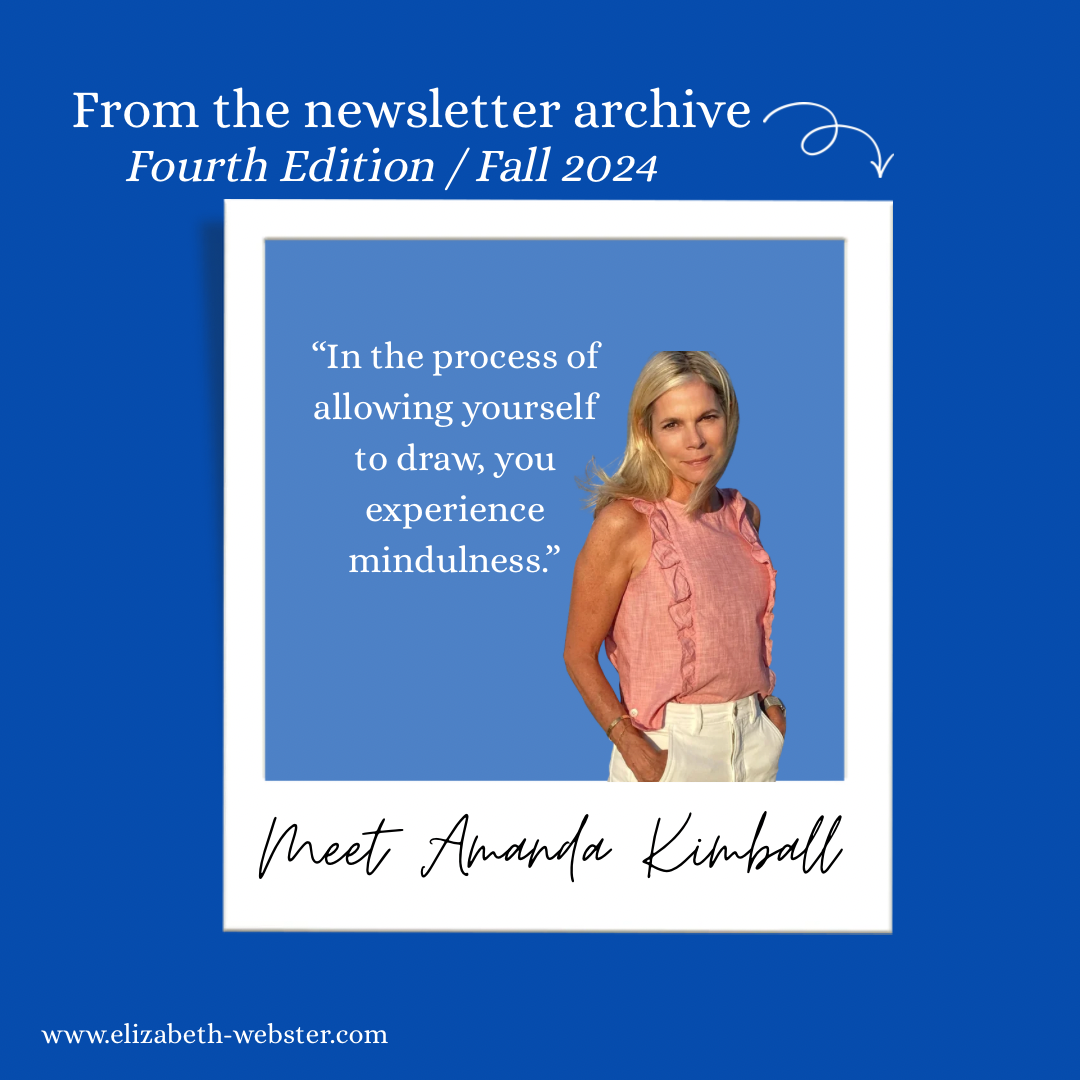
AK: A love for nature journaling and that mode of expression. I get incredible joy from being out in nature. I wanted to let them experience joy and to tie in mindfulness. Most importantly, I don’t want there to be any pressure. We aren’t making botanical art. If someone is inspired by the stem of a leaf, then that’s what they should focus on. In the process of allowing yourself to draw, you experience mindfulness.
EW: Does storytelling play a role in your paintings? Are there certain themes that you continue to revisit?
AK: Sometimes, they can tell a story. There are little vignettes, moments in time - probably from my grandparents’ houses. But [more often], I have a spark of inspiration and follow it through. It’s following the moment. Sometimes, I’ll circle back to a certain theme, but not with intention. For instance, I might paint lemons and, six months later, paint a vase with a lemon alongside it.
EW: What is your intention when you’re painting?
AK: Usually, I lose myself with that I’m doing - really, I’m not thinking about it. I’m involved in the stroke of the brush, the color, the mixing. That’s the gift of it for me - losing myself to it.
EW: Do you have any advice for people who wish to start painting, but feel overwhelmed or intimidated by it?
AK: Yes, start small. Any blank piece of paper is intimidating. I’m a big fan of skinny notebooks, such a Moleskine. Always have a good mechanical pencil or pen. Sketch little things. The easiest things [to sketch] are what you have on hand. If that’s too intimidating, you can do a rubbing, draw a frame around it, and take a look at it. Any blank page can be intimidating, but it’s just settling in. Don’t think, and you can edit later.
I’m so grateful to Amanda for these insights and for such an interesting conversation! As an aside, I had no idea as to the tremendous overlap between painting and writing. I’m sure many of you are familiar with staring at a blank page - for whatever reason - and feeling overwhelmed. I particularly love her “start small” advice for overcoming this fear.
For the most recent interviews, recipes, event details, and even more bookish content, make sure to subscribe to my quarterly newsletter below!